
During the early days of June 2014, I found myself blissfully meandering through TYPE Books on Queen Street West in Toronto where it was the cover art that initially drew me to ‘Pastoral’ by Andre Alexis.
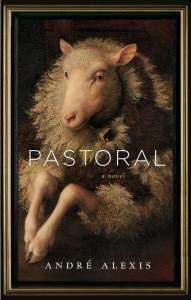
I instinctively reached to pick it up, intrigued by the juxtaposition between the cover design’s dark hues and the inferred agrarian scene conjured by the title. On reading the opening sentence, I was hooked.
“Christopher Pennant had passed through a crisis of faith” (p. 9).
Despite being deeply curious about the story that waited for me between its covers, after buying the book that day I did not return to ‘Pastoral’ until recently. When I gave my head a shake and remembered the joy and endless value reading for pleasure brings a life, the idea of a crisis of faith – and the story of a shepherd questioning his very calling – appealed to me.
Alexis opens with an introduction to his protagonist, a recently ordained priest as he leaves Ottawa for his first parish in southern Ontario’s Lamberton Country. What follows is an elegantly written novel that tells the story of Father Pennant’s first six months in Barrow, a small fictional town that naturally embodies the pastoral ideal, and the three ‘miracles’ that profoundly shake his faith. Running parallel to Father Pennant’s crisis of faith is Barrow resident Liz Denny’s crisis of the heart as she must decide if she can forgive her philandering fiance and go through with their approaching wedding.
This book is a joy to read: the prose is elegant, the characters come alive on the page, and it is wonderfully evocative of small town life. And it’s both funny and thought-provoking.
But more than that, while a relatively short novel at a succinct 162 pages, ‘Pastoral’ is beautifully constructed. Written in a style informed by an oft forgotten literary genre – the pastoral that idealizes rural life for an urban audience – Alexis’ characters must navigate a tension between the spiritual and the physical; between illusion and reality. Beyond the themes of the book Alexis cleverly, and to extraordinary effect, structures ‘Pastoral’ as “an homage to Beethoven’s Sixth Symphony, the Pastoral Symphony. The novel’s chapters follow the logic of the symphony” (p. 165) giving both the crisis of faith and the crisis of the heart dramatic arcs that rise and swell as an orchestral composition.
After being truly enthralled with this delightfully modern take on an age-old genre, I’m quite excited to tuck into Andre Alexis’ Giller Prize winning ‘Fifteen Dogs’, where he continues to play with genre, moving on from the pastoral to an apologue.
A note: While my reading habit is not nearly as prolific as Austin Kleon‘s, I do appreciate how he logs his reading, so I’ve taken his approach here by using the same blog tags.
 Jennifer Caswell